.png)
First Rule: Make Safe
In emergency response, the first instruction is simple: make the situation safe.
Firefighters, police, and utility crews all operate in the same discipline. Before investigation, before restoration, before analysis, the hazard must be stabilized. That principle is not theoretical. It is executed in seconds, under pressure, with lives and property at risk.
Gas distribution operates under the same reality.
When something goes wrong anywhere in the system—whether upstream in the distribution network or at the premise, such as a ruptured line, an over-pressure condition, appliance failure, or fire—the priority is immediate isolation of the fuel source. Historically, that has been achieved in only two ways: a person physically shutting off the gas, or a mechanical device acting automatically at the point of flow. In both cases, the response happens locally, and it happens immediately. It does not depend on a remote command traveling across a communication network.
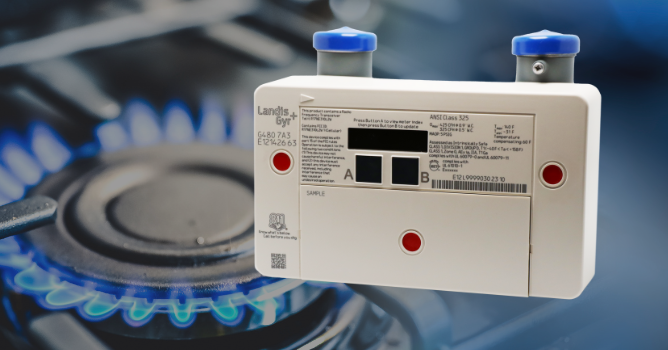
We recognized that more than a decade ago. As early as 2010, we began embedding sensing and autonomous shutoff directly into the meter—not as an add-on, but as a deliberate design choice. The objective was clear: move safety to the point where the gas is controlled and ensure that protection exists at the last point where the system can act.
At the same time, we built full remote valve control capability into the platform. That capability is not secondary—it is central to the future of gas operations. Remote control enables utilities to extend their operational reach, coordinate responses more effectively, and manage the system with a level of flexibility that did not previously exist. It supports planned operations, improves efficiency, and gives operators meaningful control at the edge of the network.
Used correctly, it is a powerful tool. But it is a tool that must be applied with discipline. Utilities must design processes and procedures that recognize where remote control adds value and where it introduces dependency. Utilities must consider the characteristic realities of low-power, battery-based systems. Endpoints sleep to preserve battery life. Networks are designed for scale and efficiency. Messages can be delayed, retried, or missed altogether. For most operational use cases, that tradeoff is acceptable. For safety, it is not.
This is not theoretical. It is a pattern the industry has encountered repeatedly. Other industries have already worked through this same challenge—and their conclusions are consistent.
In pipeline operations, early efforts to rely on intermittent telemetry for control gave way to continuously powered SCADA systems because isolation could not depend on when a signal arrived. Operators learned that if a valve must close to protect the system, it must be powered, connected, and capable of acting without delay.
In industrial environments such as refineries and chemical plants, wireless instrumentation is now widely deployed to monitor pressure, temperature, and gas presence. Yet safety shutdown systems remain wired and governed by deterministic control standards. The variability inherent in wireless communication is acceptable for visibility, but not for protective action.
Even in modern buildings filled with connected sensors and smart systems, fire protection does not rely on network commands. Sprinklers activate based on local thermal conditions. Fire alarm systems are wired. The protective action occurs where the hazard is detected, not where a signal is received.
Across each of these examples, the same lesson has emerged. Monitoring can be distributed. Safety cannot.
Throughout history, the residential gas meter was a passive device. It measured consumption and supported billing, but it did not actively participate in protecting the premise. Today’s ultrasonic meters are fundamentally different. By combining continuous sensing of pressure, temperature, and flow with an integrated shut-off capability, they evaluate conditions in real time and act when those conditions move outside safe limits.
When something abnormal occurs, the meter does not need to check in, wait for a command, or rely on network availability. It responds immediately, at the point where the gas is being delivered. It acts at the last point where the system can protect the premise.
This does not replace remote control. It completes it.
Remote capabilities give operators reach and flexibility. Autonomous protection ensures that when timing matters most, the system does not have to wait. Together, they form a system that is both operationally advanced and fundamentally safe. Utilities that deploy it effectively will design procedures that align its use with its strengths, while ensuring that safety does not depend on it.
Because when something goes wrong, the system must already be capable of acting.
It must act immediately.
It must act locally.
And it must act with certainty.


.png/_jcr_content/renditions/cq5dam.zoom.2048.2048.jpeg)
.png/_jcr_content/renditions/cq5dam.zoom.2048.2048.jpeg)


.jpeg/_jcr_content/renditions/cq5dam.zoom.2048.2048.jpeg)