
Select your language and location

Global version of landisgyr.com

Blog

Navigating the 900 MHz FCC Proceeding: 5 Key Points to Know

June 5, 2026 Blogs Regulation

Two years ago, in April 2024, a quiet request was filed at the FCC with a massive ask: NextNav, a Positioning, Navigation, and Timing (PNT) company with a history of telecommunications mergers, requested a rule change that would allow it to build out a network of high-power broadband operations. NextNav’s 5G technology would function as both a GPS backup and as low-band broadband capacity, supporting “national security” by reinforcing 16 critical infrastructure sectors that rely on today’s weak GPS signals. 

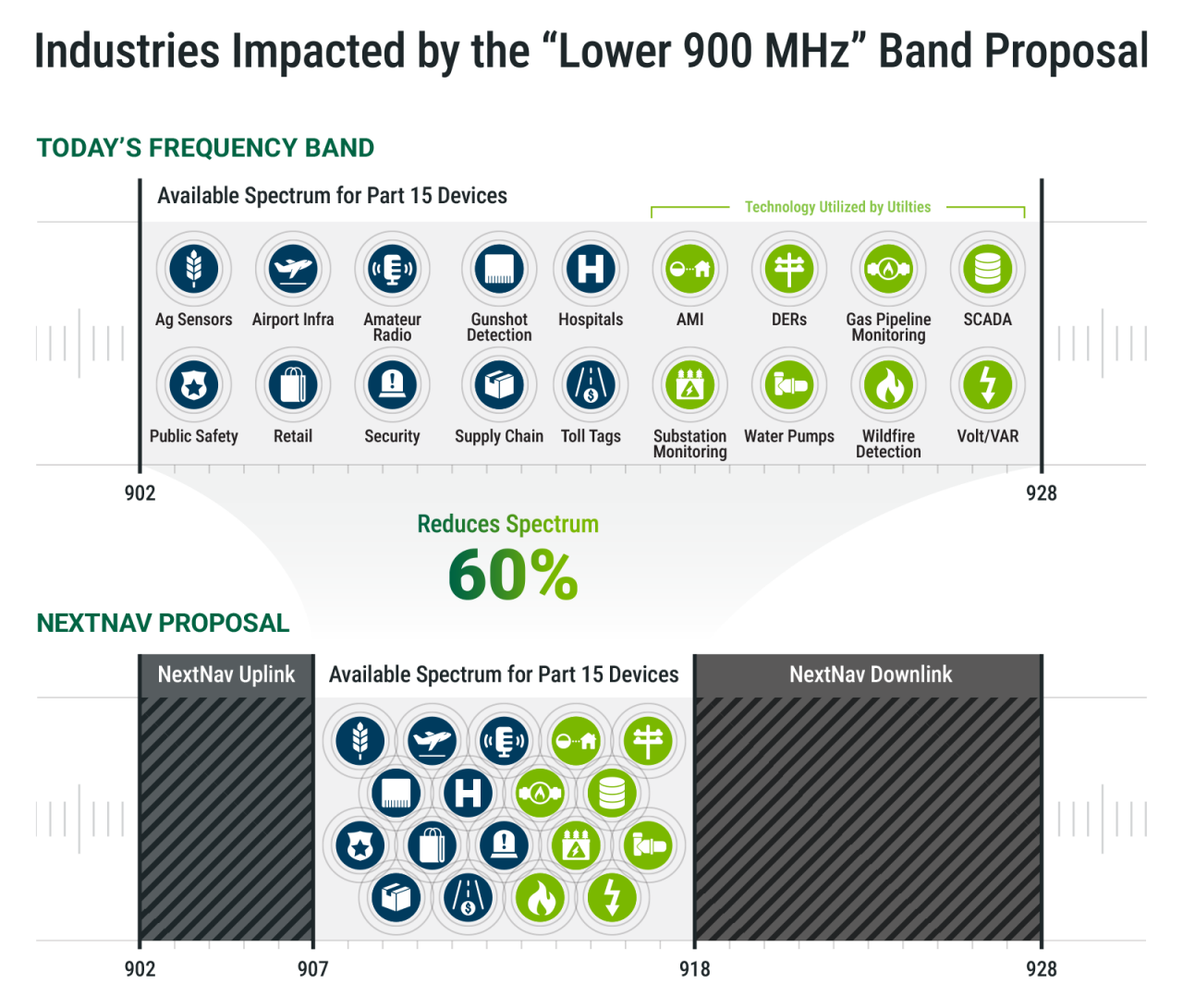
The proposal sounds appealing but comes with substantial costs and questionable methods. Beyond simply seeking licenses, the request proposed privatizing portions of the Lower 900 MHz band (902-928MHz), a band that has been set aside and is widely used for critical communications of unlicensed spectrum devices since 1985. If granted, the new spectrum occupation is anticipated to cause substantial disruptions across a variety of industries. For electric utilities alone, the cost to replace just 10% of impacted devices is estimated at $10 billion.  

Utilities rely heavily on this band to support critical grid operations. It serves as the “eyes and ears” of the grid through smart metering and communications, SCADA systems, DER monitoring, and other essential functions. Restriction of the band as proposed by NextNav could result in reduced reliability of smart metering and grid control, resulting in risks to public safety and grid stability (e.g., remote monitoring/shut-off capabilities).  

Here are five key things you need to know about this proceeding:
Point 1: What's at Stake for Utility Communications

Sources: GridWise Alliance, Electric Edison Institute 

More than 160 million smart meters currently communicate over the 900 MHz band, making it a foundational layer of utility communications infrastructure across the United States. Significant interference within the band would require reconfiguration of network design, risking grid reliability issues, inaccurate customer billing, and extensive replacement costs. This translates to higher utility bills at a time when consumers are already facing an affordability crisis, potential electricity outages that disrupt small business operations and hurt vulnerable populations, and fragmented utility customer support services—creating inconsistency and frustration.

The impact extends far beyond intelligent grid sensing meters. At least eight critical categories of grid infrastructure rely on the 900 MHz band, including: 

  • AMI
  • SCADA/RTUs
  • Distribution automation
  • Volt/VAR control
  • Fault detection
  • DER monitoring
  • Substation automation
  • Pipeline/water infrastructure

For many utilities, particularly those with rural service territories, the 900 MHz band remains one of the only practical and resilient communications options available. For example, a large regional utility may operate ~2,000 RTU sites on 900 MHz, especially in areas where fiber and cellular are unavailable. The propagation characteristics of the band allow communications to perform reliably in environments where other networks often struggle—including rural and mountainous terrain, underground infrastructure, wildfire prone regions, and severe weather conditions.

Point 2: What NextNav Is Actually Proposing

NextNav petitioned the FCC to reconfigure the band to permit nationwide high-power broadband operations. This proposal would introduce transmissions far more powerful than the low-power (“Part 15”) devices that currently share the band today, creating the potential for harmful interference with existing utility networks.

While the petition has been positioned as part of a national security effort to support a GPS-backup and 5G buildout initiative—priorities that align closely with current FCC leadership interests—the proposal does not require deployment of PNT services. In practice, it would also permit a broad range of commercial uses unrelated to PNT applications. 

Additionally, utilities and industry stakeholders continue to raise concerns about the lack of utility-validated interference testing. Industry groups have argued that NextNav’s interference modeling substantially underestimates the operational impact on existing utility networks and fails to fully account for real-world deployment conditions, despite the company’s experimental licenses and technical claims.

Further details can be found in FCC Dockets RM RM-11989 / WT 24-240 & (NextNav PNT Petition) and WT 25-110 (FCC PNT Notice of Inquiry). A March 2026 filing by the Connected Devices for America Coalition summarizes the proceedings and key concerns. 

Point 3: The Cost

According to analysis from critical utility infrastructure providers, the costs to utilities—and ratepayers—would be at least $100B, further exacerbating the affordability issues they already face. Utility bills are a particular driver of affordability issues, since electricity rates have increased 35%-45% in the last five years.

Cost ItemEstimate
Replacing all 160M meters$50B minimum
Manual meter reading during 5-year transition $25B
Lost consumer benefits from existing AMI rate cases$16B
Total~$100B

EEI estimates that the proposal will result in potential costs for each utility of up to $4 billion, spread over a 10-15-year replacement cycle. These costs would be passed to ratepayers who have already paid for useful, regulator-approved infrastructure.

Point 4: Impacts Outside of the Electric Grid 

The risks associated with this proceeding extend well beyond electric utilities, affecting multiple sectors that rely on the 900 MHz band for critical communications and operational reliability. Some examples include:


  • Natural gas pipeline SCADA and buried pipeline monitoring, required under federal PHMSA safety regulations 
  • Water pumping stations and treatment plants, designated critical infrastructure under EPA's America's Water Infrastructure Act
  • Agricultural sensors could be disrupted, including automated irrigation monitors, livestock trackers, and crop sensors
  • In-home devices and security systems, including Congressional “Panic Buttons,” security systems, doorbells, fall pendants, smart locks
  • Transportation & Logistics like Railroad AEI (Automatic Equipment Identification) systems, long-haul trucking fleet telematics and cargo tracking, and toll tags
  • Healthcare devices, like Personal Emergency Response Systems (PERS) medical alert pendants like Life Alert, hospital asset tracking (equipment, medication carts)
  • Retail & Supply Chain systems like warehouse RFID inventory systems (a substantial Part 15 user class)
  • Public Safety functions like prison/correctional facility perimeter monitoring and security systems 

Point 5: A Balanced Path Forward

Before moving toward any rulemaking, the FCC could require a comprehensive economic and infrastructure impact analysis to fully understand the potential consequences across critical industries. So far, the studies filed in the case have been produced by parties with distinct interests; a neutral evaluation would contextualize the costs and benefits (see the Connected Devices for America’s list of seven filed engineering studies that contradict NextNav’s claims). 

There is also an opportunity for NextNav to work collaboratively with utilities and other stakeholders to conduct transparent, utility-validated interference testing and cost assessments. NextNav has already started testing its system in San Jose, California, with a network of eight 5G radios, and has a pending round of tests in Pueblo, Colorado, but these tests do not yet include explicit outreach to impacted energy stakeholders. 

At the same time, the FCC and federal agencies can continue exploring alternative approaches to GPS redundancy and PNT resilience that strengthen national security without disrupting existing critical infrastructure systems. Dozens of alternatives exist that wouldn’t disrupt other businesses, including other broadband solutions, LEO satellites, quantum clocks, and broadcast positioning. 

What Happens Next?

The FCC submitted a draft Notice of Public Rulemaking in March 2026 to the OMB/OIRA offices in the White House for interagency review, a key step to launching a formal rulemaking that might grant NextNav’s proposal. Some ex parte meetings and comments continue to take place at the FCC and in other federal agencies, but new rulemaking has yet to be published.

Depending on behind-the-scenes processes and feedback, the FCC could put this on their upcoming agenda any day now. Congress has also gotten engaged: in April, the House Appropriations CJS subcommittee incorporated annual budget language that would restrict FCC funding related to this issue, and the House Energy and Commerce Committee’s Communications & Technology Subcommittee held a hearing on PNT alternatives on June 4th.

Final Thoughts

As this process moves forward, it is essential that decisions are grounded in rigorous analysis, transparent stakeholder engagement, and a balanced approach to both innovation and infrastructure protection. Ensuring the resilience of critical systems while evaluating new national security and communications priorities will be key to getting this right.

Utilities should evaluate their dependence on the 902-928 MHz band, engage with industry groups advocating on behalf of the sector, inform their representatives of the impacts,  and stay informed on developments that could affect grid operations, AMI investments, and customer service. 

By participating in the discussion today, utilities can help ensure that future spectrum decisions consider the operational realities of the electric grid and the millions of customers who depend on it every day.

Author

  • Marguerite Behringer
    Marguerite Behringer
    Director of Regulatory Policy and Industry Relations

Recent Blogs